
 Image 1 of 1
Certified Translation of a Letter of Appointment
This page provides certified translation services for appointment letters, sometimes referred to as letters of appointment or official appointment certificates. Such documents are commonly issued by institutions, professional associations, companies, universities, or government bodies to formally designate an individual to a specific position, role, or advisory capacity. Because these documents are often written in Chinese and contain formal institutional language and administrative terminology, a professionally prepared certified English translation may be required when the document is presented to organizations outside the original issuing jurisdiction.
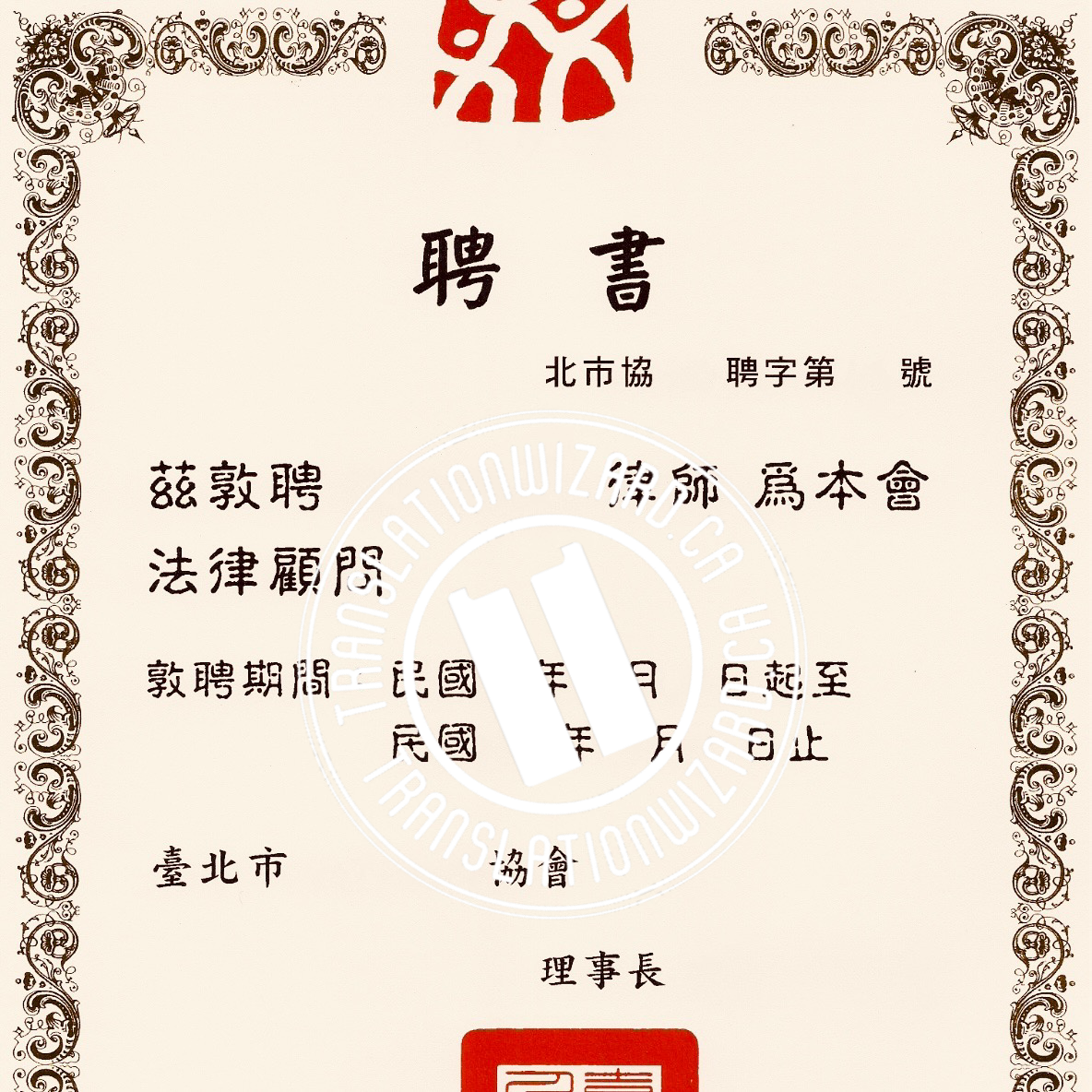
An appointment letter usually records the name of the appointed individual, the title or position to which the individual is appointed, the issuing institution, and the effective period of the appointment. In many cases, the document also includes references to the responsibilities associated with the role, the governing body responsible for the appointment, and the official signatures or seals of authorized representatives. The wording used in such documents frequently reflects a formal administrative style intended to convey authority and legitimacy.
One notable feature of many appointment letters issued by Chinese institutions is the use of concise ceremonial phrasing combined with official seals or institutional insignia. The document design itself may include decorative borders, calligraphic titles, and formal layout conventions that reflect the institutional culture of the issuing organization. These visual and textual elements serve to confirm the authenticity of the appointment and the authority under which it was granted. When translating such a document, it is important not only to render the literal meaning of the text but also to preserve the formal tone and administrative structure reflected in the original document.
Appointment letters may be required in a variety of international contexts, including professional credential verification, employment documentation, academic collaboration, or institutional representation. When these documents are submitted to authorities or organizations operating primarily in English, a certified translation helps ensure that the appointment and its institutional context are clearly understood by readers who may not be familiar with the language or administrative traditions of the issuing body.
Translations associated with such documents are prepared by a Chinese–English certified translator who is a member in good standing of both the Society of Translators and Interpreters of British Columbia (STIBC) and the Association of Translators and Interpreters of Ontario (ATIO). Certified translations prepared by a professional translator ensure that the content of the original Chinese document is accurately rendered in English while preserving the structure and formal character of the appointment record.
Certified Translation of a Letter of Appointment
This page provides certified translation services for appointment letters, sometimes referred to as letters of appointment or official appointment certificates. Such documents are commonly issued by institutions, professional associations, companies, universities, or government bodies to formally designate an individual to a specific position, role, or advisory capacity. Because these documents are often written in Chinese and contain formal institutional language and administrative terminology, a professionally prepared certified English translation may be required when the document is presented to organizations outside the original issuing jurisdiction.
An appointment letter usually records the name of the appointed individual, the title or position to which the individual is appointed, the issuing institution, and the effective period of the appointment. In many cases, the document also includes references to the responsibilities associated with the role, the governing body responsible for the appointment, and the official signatures or seals of authorized representatives. The wording used in such documents frequently reflects a formal administrative style intended to convey authority and legitimacy.
One notable feature of many appointment letters issued by Chinese institutions is the use of concise ceremonial phrasing combined with official seals or institutional insignia. The document design itself may include decorative borders, calligraphic titles, and formal layout conventions that reflect the institutional culture of the issuing organization. These visual and textual elements serve to confirm the authenticity of the appointment and the authority under which it was granted. When translating such a document, it is important not only to render the literal meaning of the text but also to preserve the formal tone and administrative structure reflected in the original document.
Appointment letters may be required in a variety of international contexts, including professional credential verification, employment documentation, academic collaboration, or institutional representation. When these documents are submitted to authorities or organizations operating primarily in English, a certified translation helps ensure that the appointment and its institutional context are clearly understood by readers who may not be familiar with the language or administrative traditions of the issuing body.
Translations associated with such documents are prepared by a Chinese–English certified translator who is a member in good standing of both the Society of Translators and Interpreters of British Columbia (STIBC) and the Association of Translators and Interpreters of Ontario (ATIO). Certified translations prepared by a professional translator ensure that the content of the original Chinese document is accurately rendered in English while preserving the structure and formal character of the appointment record.