
 Image 1 of 1
Certified Translation of an Entry–Exit Record (Customs or Immigration Travel Record)
An entry–exit record is an official document issued by immigration authorities to summarize a person’s recorded crossings of national borders within a specified period of time. Such records are typically generated by government immigration systems and may document the dates and locations at which an individual entered or departed a country or region. When presented to institutions in English-speaking jurisdictions, a certified translation may be required to ensure that the information contained in the original document can be accurately understood.
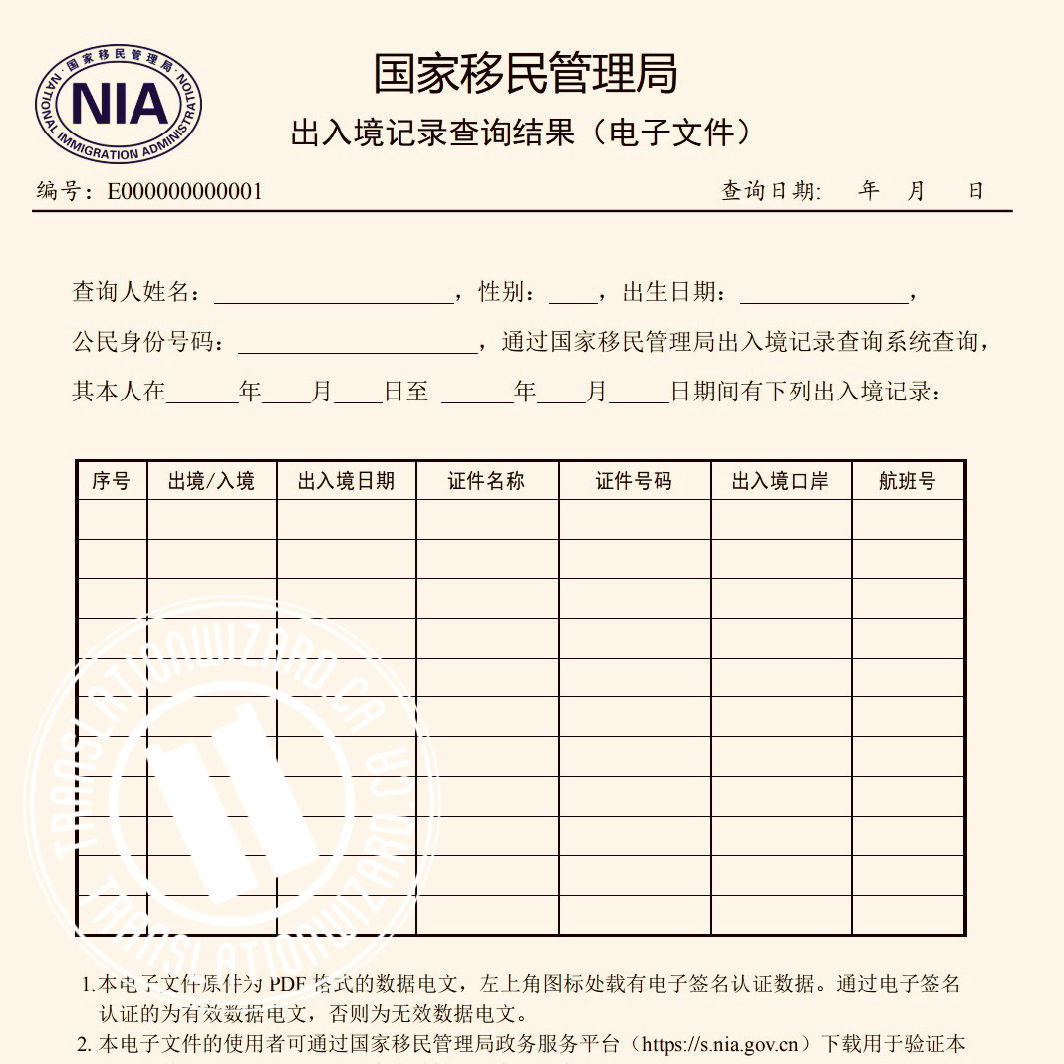
In Chinese administrative practice, entry–exit records are frequently issued in electronic document format and may be produced through an official immigration information system. The document normally begins with identifying information relating to the person whose travel history is being recorded. This information may include the individual’s name, gender, date of birth, and identification number, allowing the record to be associated with the correct person in the national database.
The central portion of the document usually consists of a tabulated list of travel entries. Each row of the table represents a specific border-crossing event and may contain several types of information. These commonly include whether the movement represents entry or exit, the date of the movement, the type of identity document used, the document number, and the port through which the individual crossed the border. In some cases, additional references such as transportation details or flight numbers may also appear. The structured layout of this table allows officials or institutions reviewing the record to quickly understand the chronology of travel activities within the designated timeframe.
Another feature of many entry–exit records is the presence of official document identifiers or verification elements. These may include document numbers, electronic certification references, or statements indicating that the record was generated by an immigration administration authority. Such elements help confirm that the document reflects information retrieved from an official governmental system rather than a private record.
Certified translations associated with entry–exit records are prepared by a Chinese–English certified translator accredited by the Society of Translators and Interpreters of British Columbia (STIBC) and the Association of Translators and Interpreters of Ontario (ATIO). Certified translation ensures that institutional terminology, border-control references, and the structured travel data appearing in the original document are accurately conveyed in English while preserving the informational structure of the source record.
Certified Translation of an Entry–Exit Record (Customs or Immigration Travel Record)
An entry–exit record is an official document issued by immigration authorities to summarize a person’s recorded crossings of national borders within a specified period of time. Such records are typically generated by government immigration systems and may document the dates and locations at which an individual entered or departed a country or region. When presented to institutions in English-speaking jurisdictions, a certified translation may be required to ensure that the information contained in the original document can be accurately understood.
In Chinese administrative practice, entry–exit records are frequently issued in electronic document format and may be produced through an official immigration information system. The document normally begins with identifying information relating to the person whose travel history is being recorded. This information may include the individual’s name, gender, date of birth, and identification number, allowing the record to be associated with the correct person in the national database.
The central portion of the document usually consists of a tabulated list of travel entries. Each row of the table represents a specific border-crossing event and may contain several types of information. These commonly include whether the movement represents entry or exit, the date of the movement, the type of identity document used, the document number, and the port through which the individual crossed the border. In some cases, additional references such as transportation details or flight numbers may also appear. The structured layout of this table allows officials or institutions reviewing the record to quickly understand the chronology of travel activities within the designated timeframe.
Another feature of many entry–exit records is the presence of official document identifiers or verification elements. These may include document numbers, electronic certification references, or statements indicating that the record was generated by an immigration administration authority. Such elements help confirm that the document reflects information retrieved from an official governmental system rather than a private record.
Certified translations associated with entry–exit records are prepared by a Chinese–English certified translator accredited by the Society of Translators and Interpreters of British Columbia (STIBC) and the Association of Translators and Interpreters of Ontario (ATIO). Certified translation ensures that institutional terminology, border-control references, and the structured travel data appearing in the original document are accurately conveyed in English while preserving the informational structure of the source record.