
 Image 1 of 1
Certified Translation of a Receipt or Payment Receipt
This page provides certified translation services for receipts and payment receipts originally issued in Chinese. Receipts are common financial documents used to confirm that a payment has been made or that funds have been received by an individual, business, or institution. Because receipts are frequently submitted as supporting documentation in administrative, legal, or financial contexts, a certified English translation may be required when the document is presented to authorities or organizations outside the language of issuance.
A receipt typically records essential information related to a transaction. This information may include the name of the issuing organization or individual, the date of payment, the amount received, the currency, and a description of the goods or services associated with the transaction. In many cases the receipt also contains a serial number, accounting references, or handwritten notes confirming the completion of the payment. The layout of a receipt often follows a tabular or form-based format designed to clearly document the details of a financial exchange.
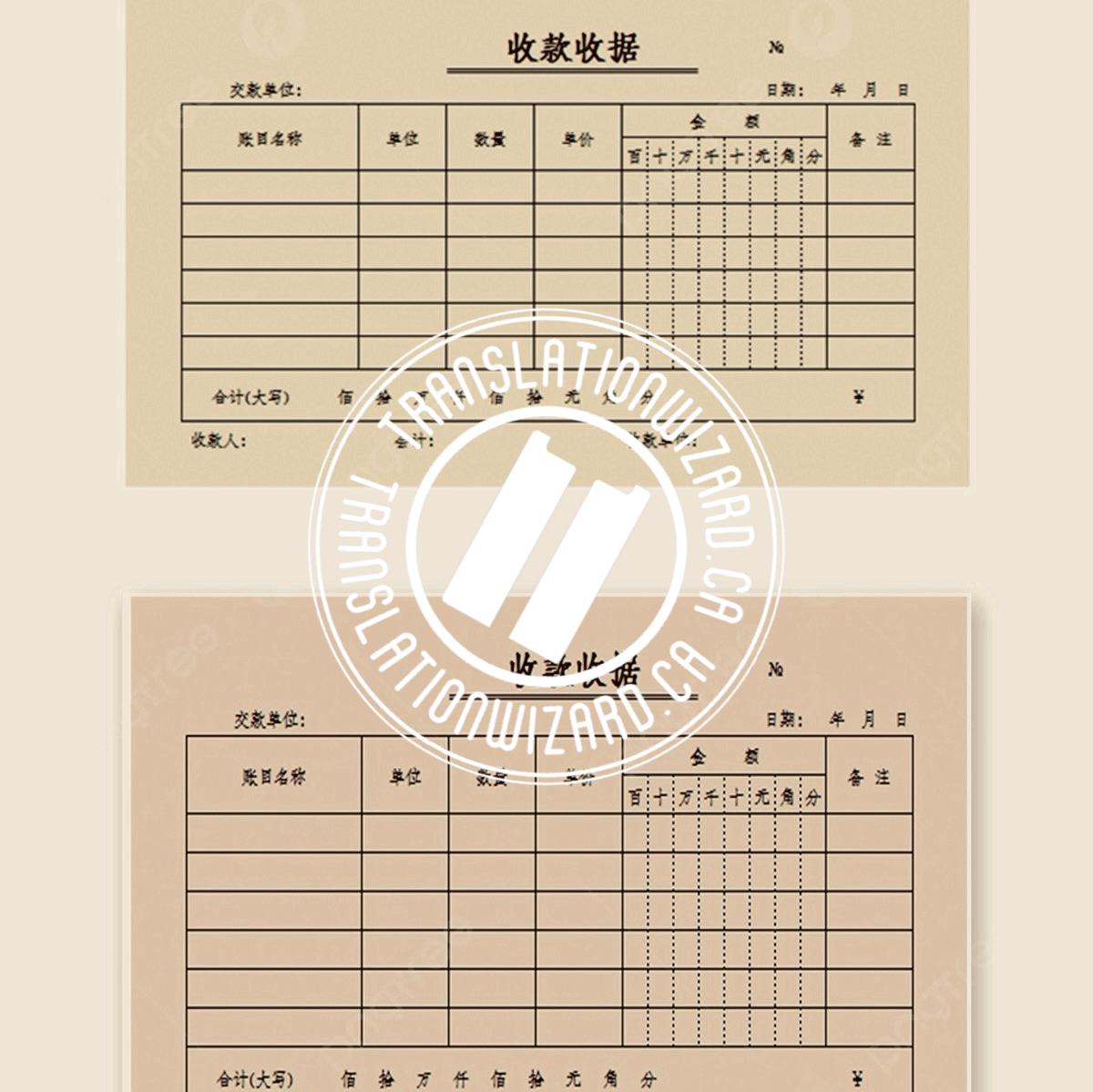
Receipts produced in Chinese-language administrative systems often include structured financial fields, such as columns for item descriptions, quantities, unit prices, and total amounts. The document may also include official seals, financial stamps, or institutional markings that confirm the authenticity of the transaction. Because financial terminology, accounting conventions, and document layouts may differ between countries, translating a receipt requires careful attention to terminology so that the financial meaning of the document remains clear to readers unfamiliar with the original system.
In international contexts, translated receipts may accompany applications, expense records, immigration documentation, tax submissions, or financial reporting materials. Institutions reviewing these documents rely on accurate translations in order to understand the nature of the transaction and the information recorded on the original receipt. Maintaining the structure of the document, such as itemized lists, totals, and currency references, helps ensure that the translated version reflects the original financial record faithfully.
Translations associated with financial and administrative documents are prepared by a Chinese–English certified translator accredited by the Society of Translators and Interpreters of British Columbia (STIBC) and the Association of Translators and Interpreters of Ontario (ATIO). Certified translations help ensure that financial terminology, document structure, and recorded transaction details are conveyed clearly in English while preserving the integrity of the original receipt.
Certified Translation of a Receipt or Payment Receipt
This page provides certified translation services for receipts and payment receipts originally issued in Chinese. Receipts are common financial documents used to confirm that a payment has been made or that funds have been received by an individual, business, or institution. Because receipts are frequently submitted as supporting documentation in administrative, legal, or financial contexts, a certified English translation may be required when the document is presented to authorities or organizations outside the language of issuance.
A receipt typically records essential information related to a transaction. This information may include the name of the issuing organization or individual, the date of payment, the amount received, the currency, and a description of the goods or services associated with the transaction. In many cases the receipt also contains a serial number, accounting references, or handwritten notes confirming the completion of the payment. The layout of a receipt often follows a tabular or form-based format designed to clearly document the details of a financial exchange.
Receipts produced in Chinese-language administrative systems often include structured financial fields, such as columns for item descriptions, quantities, unit prices, and total amounts. The document may also include official seals, financial stamps, or institutional markings that confirm the authenticity of the transaction. Because financial terminology, accounting conventions, and document layouts may differ between countries, translating a receipt requires careful attention to terminology so that the financial meaning of the document remains clear to readers unfamiliar with the original system.
In international contexts, translated receipts may accompany applications, expense records, immigration documentation, tax submissions, or financial reporting materials. Institutions reviewing these documents rely on accurate translations in order to understand the nature of the transaction and the information recorded on the original receipt. Maintaining the structure of the document, such as itemized lists, totals, and currency references, helps ensure that the translated version reflects the original financial record faithfully.
Translations associated with financial and administrative documents are prepared by a Chinese–English certified translator accredited by the Society of Translators and Interpreters of British Columbia (STIBC) and the Association of Translators and Interpreters of Ontario (ATIO). Certified translations help ensure that financial terminology, document structure, and recorded transaction details are conveyed clearly in English while preserving the integrity of the original receipt.