
 Image 1 of 1
Certified Translation of a Medical Diagnosis Certificate
This page provides certified translation services for medical diagnosis certificates issued by hospitals, clinics, and other authorized medical institutions in mainland China and other Chinese-speaking regions. A diagnosis certificate is an official medical document summarizing the findings of a clinical examination and recording the physician’s medical conclusion regarding a patient’s health condition at the time of consultation. Such documents are commonly issued following outpatient visits, medical examinations, or clinical assessments and serve as formal records of medical evaluation. When these certificates are presented outside Chinese-speaking jurisdictions, a certified English translation may be required to ensure that the medical information contained in the document can be accurately understood by institutions operating in English-language environments.
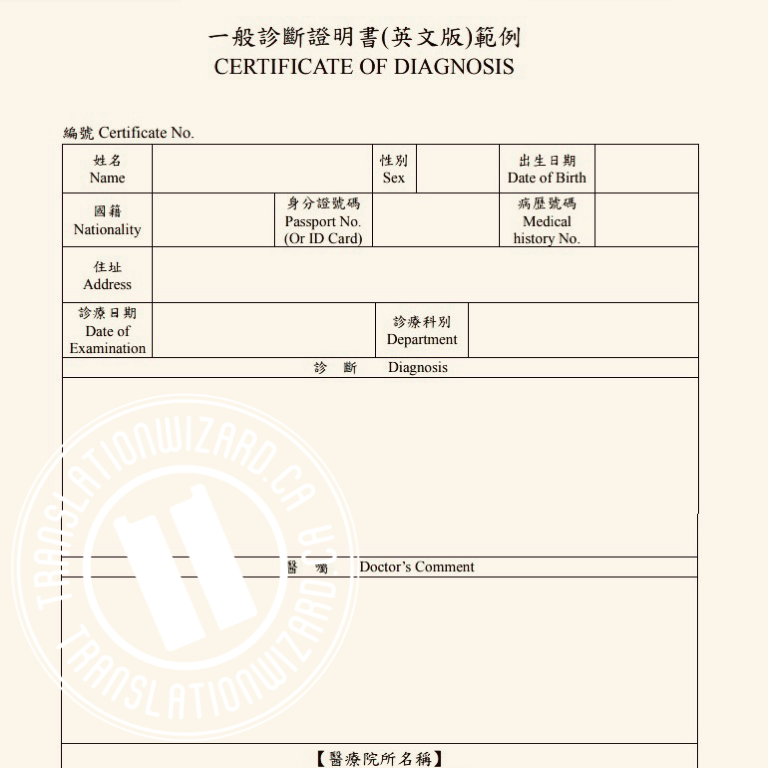
Medical diagnosis certificates generally follow a standardized administrative layout designed to record both patient identification details and clinical information associated with the consultation. Typical fields include the patient’s name, sex, date of birth, nationality, identification number or passport number, and residential address. The document may also contain a medical history number or patient record number associated with the healthcare institution. These administrative details establish the identity of the patient and link the diagnosis to the institutional medical record maintained by the issuing facility.
In addition to identification information, diagnosis certificates normally record details relating to the medical consultation itself. These may include the date of examination, the medical department in which the consultation occurred, and the physician’s diagnostic conclusion. The diagnostic section may summarize the physician’s clinical findings, the nature of the condition observed, or the medical assessment made during the examination. Some certificates also include a section for additional physician remarks or comments, allowing the attending doctor to provide further clarification regarding the patient’s medical condition or relevant observations made during the consultation.
Diagnosis certificates issued by hospitals often contain official elements confirming their institutional origin. These may include hospital names, departmental designations, institutional seals, or other administrative markings used by medical facilities to authenticate clinical documentation. The layout is typically structured in tabular form so that patient information, examination details, and diagnostic statements can be recorded in clearly separated sections. Translating such documents requires careful attention to medical terminology, administrative headings, and clinical language so that the meaning of each section is conveyed accurately in English while preserving the original structure of the certificate.
Translations associated with medical documentation are prepared by a Chinese–English certified translator accredited by the Society of Translators and Interpreters of British Columbia (STIBC) and the Association of Translators and Interpreters of Ontario (ATIO). Certified translations help ensure that patient identification details, diagnostic terminology, and institutional references appearing in the original medical certificate are accurately rendered in English while maintaining the informational structure of the official document.
Certified Translation of a Medical Diagnosis Certificate
This page provides certified translation services for medical diagnosis certificates issued by hospitals, clinics, and other authorized medical institutions in mainland China and other Chinese-speaking regions. A diagnosis certificate is an official medical document summarizing the findings of a clinical examination and recording the physician’s medical conclusion regarding a patient’s health condition at the time of consultation. Such documents are commonly issued following outpatient visits, medical examinations, or clinical assessments and serve as formal records of medical evaluation. When these certificates are presented outside Chinese-speaking jurisdictions, a certified English translation may be required to ensure that the medical information contained in the document can be accurately understood by institutions operating in English-language environments.
Medical diagnosis certificates generally follow a standardized administrative layout designed to record both patient identification details and clinical information associated with the consultation. Typical fields include the patient’s name, sex, date of birth, nationality, identification number or passport number, and residential address. The document may also contain a medical history number or patient record number associated with the healthcare institution. These administrative details establish the identity of the patient and link the diagnosis to the institutional medical record maintained by the issuing facility.
In addition to identification information, diagnosis certificates normally record details relating to the medical consultation itself. These may include the date of examination, the medical department in which the consultation occurred, and the physician’s diagnostic conclusion. The diagnostic section may summarize the physician’s clinical findings, the nature of the condition observed, or the medical assessment made during the examination. Some certificates also include a section for additional physician remarks or comments, allowing the attending doctor to provide further clarification regarding the patient’s medical condition or relevant observations made during the consultation.
Diagnosis certificates issued by hospitals often contain official elements confirming their institutional origin. These may include hospital names, departmental designations, institutional seals, or other administrative markings used by medical facilities to authenticate clinical documentation. The layout is typically structured in tabular form so that patient information, examination details, and diagnostic statements can be recorded in clearly separated sections. Translating such documents requires careful attention to medical terminology, administrative headings, and clinical language so that the meaning of each section is conveyed accurately in English while preserving the original structure of the certificate.
Translations associated with medical documentation are prepared by a Chinese–English certified translator accredited by the Society of Translators and Interpreters of British Columbia (STIBC) and the Association of Translators and Interpreters of Ontario (ATIO). Certified translations help ensure that patient identification details, diagnostic terminology, and institutional references appearing in the original medical certificate are accurately rendered in English while maintaining the informational structure of the official document.