
 Image 1 of 1
Certified Translation of a PRC Birth Notarial Certificate
This page provides certified translation services for Birth Notarial Certificates issued by notary offices in the People’s Republic of China. A birth notarial certificate is an official legal document prepared by a Chinese notary office to confirm the birth information of an individual based on underlying civil records, household registration data, or other official documentation available to the notarial authority. Unlike a hospital birth certificate, which is issued by a medical institution at the time of birth, a birth notarial certificate is issued by a state-authorized notarial office and serves as a formal legal certification of birth facts. When such documents are presented outside mainland China, a certified English translation may be required so that the legal information contained in the certificate can be clearly understood by institutions operating in English-language environments.
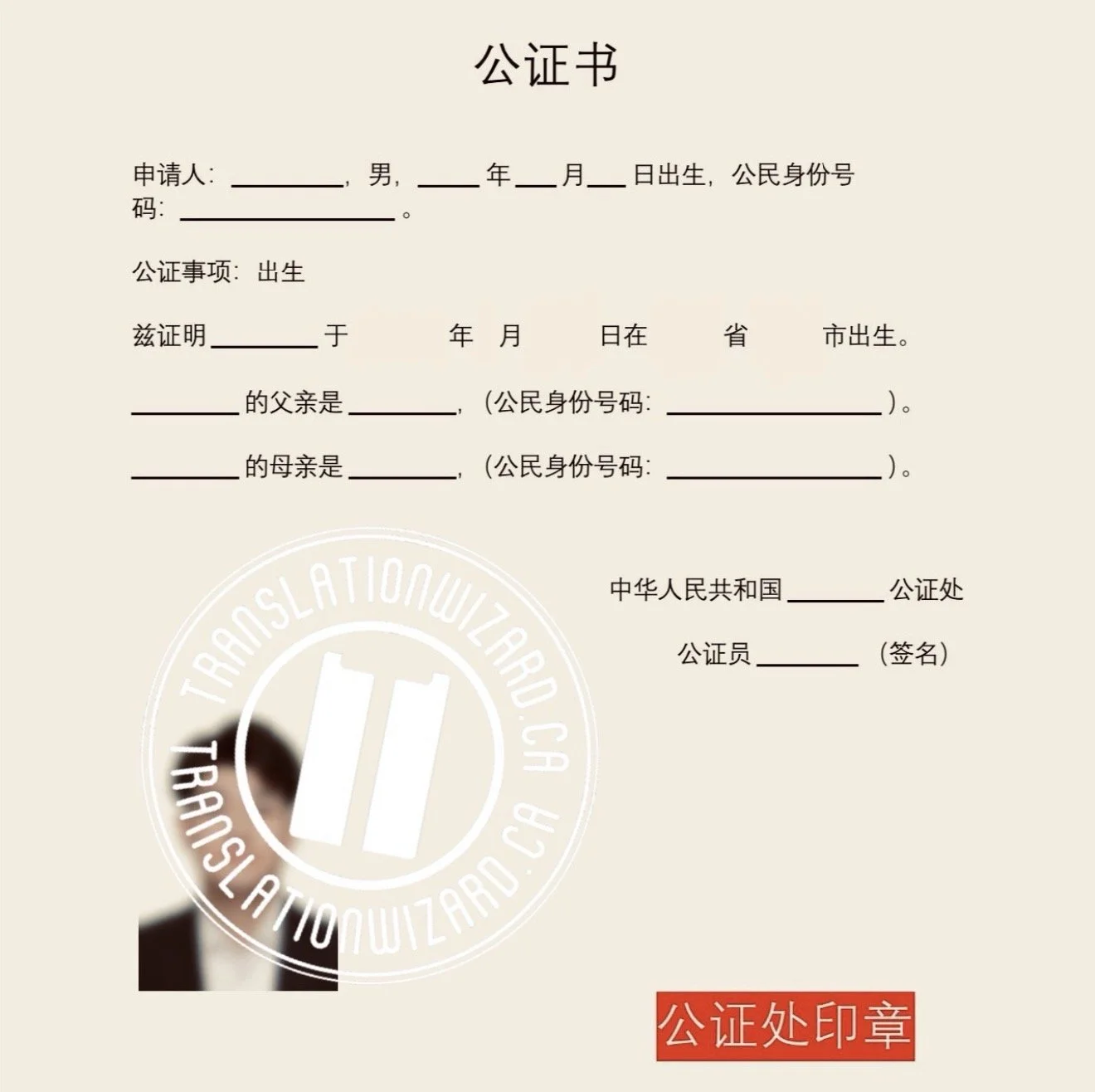
Birth notarial certificates issued in mainland China generally follow a standardized narrative format rather than a purely tabular form. The document normally identifies the applicant and confirms the essential facts of birth through a formal notarial statement. This statement typically includes the individual’s name, sex, date of birth, and place of birth, along with the names and identifying information of the parents. The notarial text affirms that the stated information has been verified according to records examined by the notarial authority. Because the document functions as a legal certification rather than a primary birth record, the language used in the certificate often reflects formal legal phrasing characteristic of Chinese notarial documents.
Another distinctive feature of PRC birth notarial certificates is the presence of official notarial elements confirming the authority of the issuing office. The document usually bears the name of the notary office, the signature of a licensed notary public, and an official notarial seal. These elements certify that the information contained in the document has been reviewed and formally attested by the notarial institution. Such certificates are widely used in international contexts where a formally notarized confirmation of birth information is required.
Because birth notarial certificates combine narrative legal language with personal identification details, translating them requires careful attention to both legal terminology and personal data fields. The translation must accurately convey the structure of the notarial statement, the relationship between the individual and their parents, and the institutional references associated with the issuing notary office. Preserving the legal tone and structure of the document helps ensure that the translated certificate reflects the official nature of the original notarial record.
Translations associated with legal and civil documentation are prepared by a Chinese–English certified translator accredited by the Society of Translators and Interpreters of British Columbia (STIBC) and the Association of Translators and Interpreters of Ontario (ATIO). Certified translations help ensure that personal identification details, legal statements, and institutional references appearing in the original notarial certificate are accurately rendered in English while maintaining the informational structure of the official document.
Certified Translation of a PRC Birth Notarial Certificate
This page provides certified translation services for Birth Notarial Certificates issued by notary offices in the People’s Republic of China. A birth notarial certificate is an official legal document prepared by a Chinese notary office to confirm the birth information of an individual based on underlying civil records, household registration data, or other official documentation available to the notarial authority. Unlike a hospital birth certificate, which is issued by a medical institution at the time of birth, a birth notarial certificate is issued by a state-authorized notarial office and serves as a formal legal certification of birth facts. When such documents are presented outside mainland China, a certified English translation may be required so that the legal information contained in the certificate can be clearly understood by institutions operating in English-language environments.
Birth notarial certificates issued in mainland China generally follow a standardized narrative format rather than a purely tabular form. The document normally identifies the applicant and confirms the essential facts of birth through a formal notarial statement. This statement typically includes the individual’s name, sex, date of birth, and place of birth, along with the names and identifying information of the parents. The notarial text affirms that the stated information has been verified according to records examined by the notarial authority. Because the document functions as a legal certification rather than a primary birth record, the language used in the certificate often reflects formal legal phrasing characteristic of Chinese notarial documents.
Another distinctive feature of PRC birth notarial certificates is the presence of official notarial elements confirming the authority of the issuing office. The document usually bears the name of the notary office, the signature of a licensed notary public, and an official notarial seal. These elements certify that the information contained in the document has been reviewed and formally attested by the notarial institution. Such certificates are widely used in international contexts where a formally notarized confirmation of birth information is required.
Because birth notarial certificates combine narrative legal language with personal identification details, translating them requires careful attention to both legal terminology and personal data fields. The translation must accurately convey the structure of the notarial statement, the relationship between the individual and their parents, and the institutional references associated with the issuing notary office. Preserving the legal tone and structure of the document helps ensure that the translated certificate reflects the official nature of the original notarial record.
Translations associated with legal and civil documentation are prepared by a Chinese–English certified translator accredited by the Society of Translators and Interpreters of British Columbia (STIBC) and the Association of Translators and Interpreters of Ontario (ATIO). Certified translations help ensure that personal identification details, legal statements, and institutional references appearing in the original notarial certificate are accurately rendered in English while maintaining the informational structure of the official document.