
 Image 1 of 1
Certified Translation of a Bank Statement or Account Transaction Record
This page provides certified translation services for bank statements and account transaction records originally issued in Chinese. A bank statement is an official financial document produced by a financial institution to summarize the activity of a bank account over a specified period of time. Because such documents contain detailed financial information and structured transaction records, an accurate English translation may be required when the statement is submitted to institutions operating in a different language environment.
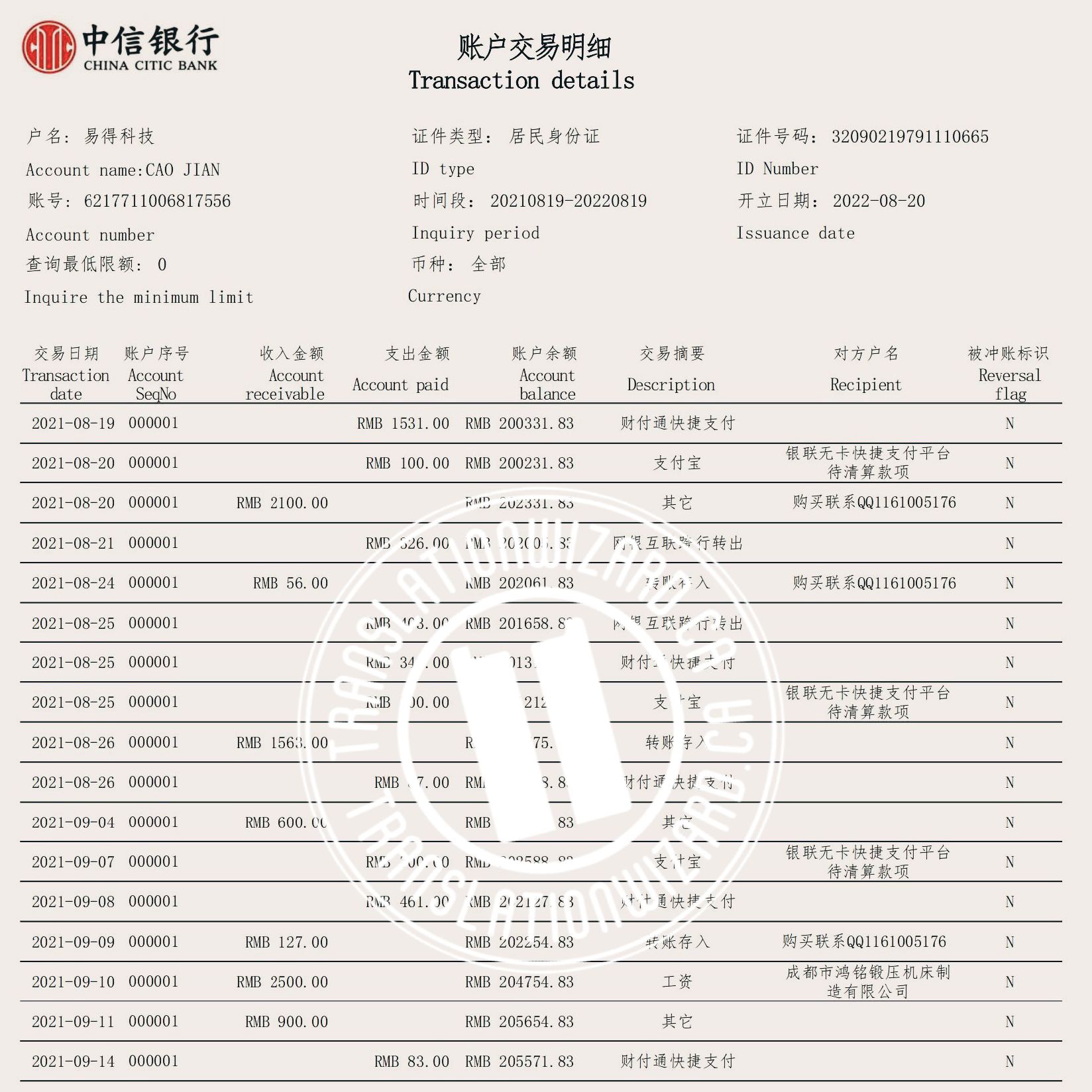
A typical bank statement presents the account holder’s information together with a chronological record of transactions occurring within the account. These records often include the account name, account number, reporting period, currency, and the issuing bank. The transaction section usually lists each deposit or withdrawal together with the transaction date, description of the transaction, amount credited or debited, and the resulting account balance. In many statements, additional fields may also appear, such as transaction references, recipient information, or internal banking codes associated with the financial system of the issuing institution.
Bank statements produced within Chinese banking systems frequently follow standardized financial formats designed for clarity and auditability. Tables typically present columns for incoming funds, outgoing payments, running balances, and descriptions of the transaction. Certain entries may reference digital payment platforms, internal transfer systems, or salary deposits depending on the nature of the financial activity recorded. Because terminology and banking conventions may differ between financial systems, translation requires careful attention so that the meaning of each transaction field remains clear to readers who are unfamiliar with the original banking structure.
In international administrative contexts, translated bank statements are often used as supporting documentation in financial verification, immigration applications, educational funding records, or other institutional reviews requiring proof of financial activity. Institutions reviewing such documents rely on accurate translations to interpret the transaction information contained in the original statement. Maintaining the structure of the document (including transaction tables, balances, and chronological order) helps ensure that the translated version faithfully represents the financial record of the account.
Translations associated with financial documents are prepared by a Chinese–English certified translator accredited by the Society of Translators and Interpreters of British Columbia (STIBC) and the Association of Translators and Interpreters of Ontario (ATIO). Certified translations help ensure that financial terminology, transaction descriptions, and institutional references are conveyed accurately in English while preserving the structure and informational integrity of the original bank statement.
Certified Translation of a Bank Statement or Account Transaction Record
This page provides certified translation services for bank statements and account transaction records originally issued in Chinese. A bank statement is an official financial document produced by a financial institution to summarize the activity of a bank account over a specified period of time. Because such documents contain detailed financial information and structured transaction records, an accurate English translation may be required when the statement is submitted to institutions operating in a different language environment.
A typical bank statement presents the account holder’s information together with a chronological record of transactions occurring within the account. These records often include the account name, account number, reporting period, currency, and the issuing bank. The transaction section usually lists each deposit or withdrawal together with the transaction date, description of the transaction, amount credited or debited, and the resulting account balance. In many statements, additional fields may also appear, such as transaction references, recipient information, or internal banking codes associated with the financial system of the issuing institution.
Bank statements produced within Chinese banking systems frequently follow standardized financial formats designed for clarity and auditability. Tables typically present columns for incoming funds, outgoing payments, running balances, and descriptions of the transaction. Certain entries may reference digital payment platforms, internal transfer systems, or salary deposits depending on the nature of the financial activity recorded. Because terminology and banking conventions may differ between financial systems, translation requires careful attention so that the meaning of each transaction field remains clear to readers who are unfamiliar with the original banking structure.
In international administrative contexts, translated bank statements are often used as supporting documentation in financial verification, immigration applications, educational funding records, or other institutional reviews requiring proof of financial activity. Institutions reviewing such documents rely on accurate translations to interpret the transaction information contained in the original statement. Maintaining the structure of the document (including transaction tables, balances, and chronological order) helps ensure that the translated version faithfully represents the financial record of the account.
Translations associated with financial documents are prepared by a Chinese–English certified translator accredited by the Society of Translators and Interpreters of British Columbia (STIBC) and the Association of Translators and Interpreters of Ontario (ATIO). Certified translations help ensure that financial terminology, transaction descriptions, and institutional references are conveyed accurately in English while preserving the structure and informational integrity of the original bank statement.